Documentary database

The Diversithèque©

Documentary database

Accordia continuously monitors best practices in terms of inclusion.
We offer you a rigorous selection of external resources on diversity and inclusion.

This enriching collection is designed to enlighten and inspire all those seeking to deepen their knowledge of inclusion issues.

Filter

Filter by

Which period?

Baromètre Autre Cercle - Ifop 2020 - Inclusion of LGBT+ people at work in France


🌈 Inclusion of LGBT+ People at Work: Baromètre Autre Cercle - Ifop 2020

The Baromètre Autre Cercle - Ifop 2020 offers a detailed analysis of the experience of LGBT+ people in the French workplace. Through this survey of LGBT+ and non-LGBT employees in organizations that have signed the LGBT+ Commitment Charter, the study sheds light on discrimination, employee expectations and the actions needed to improve inclusion.

📋 LGBTphobic discrimination at work

  1. Harassment and assault :
    • 24% of working LGBT+ people have experienced at least one LGBTphobic attack in their organization.
    • The most commonly reported behaviors include teasing, insults and shunning.
  2. LGBTphobic expressions :
    • 55% of LGBT+ employees regularly hear discriminatory expressions, such as "it's not a queer job".
  3. Impact on the quarry :
    • 18% of LGBT+ employees report inequality in terms of assignments or career development.

🌟 Visibility and well-being of LGBT+ people

  1. Visibility at work :
    • Only 33% of LGBT+ people say they are visible to their colleagues, and less than 16% to their superiors.
  2. Consequences of non-visibility :
    • 35% of non-visible LGBT+ people report a negative impact on their daily well-being.
  3. Reactions to coming out :
    • 81% of non-LGBT employees say they are comfortable with a colleague coming out, but resistance persists.

🛠️ Priority actions for inclusion

LGBT+ employees identify several levers for strengthening inclusion:

  1. Awareness: Train managers (64%) and all teams (62%) to prevent discriminatory behavior.
  2. Diversity referent: Introduce a dedicated role to support LGBT+ employees (50%).
  3. Visible allies: Promoting LGBT+ allies and role models (37%).

🔑 LGBT+ Commitment Charter

The Charter, signed by 137 public and private organizations, is a key tool for promoting inclusion.

  • 62% of employees in signatory organizations are aware of the Charter, and 84% support this commitment.
  • 42% of LGBT+ people feel that the Charter has improved their visibility at work.
Home | L'Autre Cercle

Go to data sheet

Chiffres-Clés des Inégalités Femmes-Hommes - Centre Hubertine Auclert


🌟 Les Chiffres-Clés des Inégalités Femmes-Hommes : État des Lieux et Enjeux

The Centre Hubertine Auclert's Chiffres-Clés des Inégalités Femmes-Hommes report compiles essential data for understanding the extent of inequalities in various fields such as education, employment, gender-based violence and cultural representations. By highlighting data from the Paris region and the rest of France, this booklet aims to raise awareness of structural inequalities among the general public and decision-makers, and to encourage concrete action.

📋 Persistent systemic inequalities

Inequalities between women and men are rooted in all aspects of social and professional life. They are fuelled by gender stereotypes, sexism and direct and indirect discrimination. Among the main findings:

  • In education: Girls predominate in literary and social studies, which are often less valued on the job market, while boys dominate scientific and technical studies.
  • In employment: In Île-de-France, women earn on average 18.5% less than men on a full-time basis. They also hold the majority of part-time jobs (18% vs. 6% for men).
  • In domestic life: Women spend 1h26 more a day than men on household and parental tasks.
  • In public spaces: 63% of Ile-de-France women say they are afraid in public spaces, compared with 30.5% of men.

⚖️ The impact of inequality

The consequences of these disparities are felt throughout life:

  • Pay gap: The wide gap between men's and women's incomes is reflected in retirement pensions, where women receive 42% less than their male counterparts.
  • Health and precariousness: 64% of women say they have had to postpone or forego treatment for financial or organizational reasons.
  • Violence: One Francilienne woman in three reports having been subjected to sexist or sexual violence in the public space.

🛠️ Recommendations for reducing inequality

  1. Educating for equality
    Integrate educational programs from an early age to deconstruct gender stereotypes.
  2. Promote professional equality
    Implement pay equity policies and encourage balanced representation in positions of responsibility.
  3. Improving safety in public spaces
    Develop local initiatives to make travel safer and raise awareness of sexist behavior.
  4. Supporting victims of violence
    Improve listening, reception and support services for women victims of violence.

Les chiffres-clés des inégalités femmes-hommes | Centre Hubertine Auclert

Go to data sheet

Practical guide to drawing up a professional equality action plan - Centre Hubertine Auclert


🌟 Drawing up a Professional Equality Action Plan: Practical Guide

The Guide pratique pour réaliser un plan d'action relatif à l'égalité professionnelle, published by the Centre Hubertine Auclert, provides a methodological framework for local authorities to combat gender inequality and promote professional equality. The guide is based on legal obligations reinforced by the 2019 law on the transformation of the civil service, and offers concrete tools for drawing up coherent action plans.

📋 Why a professional equality action plan?

Despite the significant feminization of the territorial civil service (61% of agents in 2017), significant gaps remain in the following areas:

  • Access to positions of responsibility: Women account for 34% of Chief Operating Officers (COOs) in large local authorities.
  • Pay gap: In category A, women earn on average 19% less than men.
  • Work-life balance: Women are over-represented in part-time and non-full-time jobs.

These inequalities undermine the internal cohesion and overall performance of public organizations.

🛠️ Steps to build an action plan

1️⃣ Initial diagnosis

The diagnosis identifies the gaps in the situation between men and women. It is based on key indicators:

  • Breakdown of workforce by gender, category and branch.
  • Rate of promotion and access to training.
  • Parental leave (maternity, paternity, parental).
  • Pay differentials, including bonuses and overtime.

2️⃣ Define action priorities

Priorities must respond to identified gaps. For example:

  • Closing the pay gap.
  • Promoting women's access to management positions.
  • Encourage fair use of parental leave.

3️⃣ Develop a structured action plan

The plan must include measurable objectives and monitoring indicators. It is organized around four main axes:

  • Reducing pay gaps.
  • Equitable access to positions and promotions.
  • Work-life balance.
  • Preventing discrimination and gender-based violence.

4️⃣ Managing and evaluating the plan

Annual monitoring is essential to measure progress. The plan must be shared with all stakeholders and be the subject of a final evaluation.

💡 Examples of inspiring actions

  • Mentoring for women executives: Support women's career paths by setting up a mentoring system.
  • Neutralizing part-time work: Ensuring that part-time work does not have a negative impact on promotions or raises.
  • Awareness: Train managers to identify and prevent unconscious bias.
  • Inclusive communication: Adapt internal materials to encourage equality, such as feminized job offers.

"Égalité professionnelle : réaliser un plan d'action" - Practical guide | Centre Hubertine Auclert

Go to data sheet

Memento for school heads - Centre Hubertine Auclert


🌟 Memento to Promote Equality and Combat Sexism and LGBTQIAPHobies in Education

The Memento à l'usage des chefs et chefs d'établissement is a practical guide designed to help schools implement policies that promote equality between girls and boys, while actively combating sexism and LGBTQIAphobic discrimination. The document offers tools, indicators and concrete actions to integrate into educational projects.

📋 Background and objectives

Despite advances in equality, gender stereotypes and discrimination based on sexual identity or orientation persist in school environments. This guide aims to :

  • Raising awareness of gender inequality and discrimination within the educational community.
  • Equipping establishments to prevent and deal with sexist and LGBTQIAphobic violence.
  • Promoting a culture of inclusion and mutual respect.

🛠️ Tools and methodology

  1. Shared diagnosis
    • Collect gendered data on incidents, sanctions and school career paths.
    • Identify sexist behavior and LGBTQIAphobic violence and integrate them into action plans.
  2. Educational activities
    • Set up training programs to raise awareness among teachers and educational staff.
    • Organize themed workshops on gender stereotypes, diversity and respect.
  3. Communication and awareness-raising
    • Integrate these issues into school events (press week, anti-violence days).
    • Use educational tools such as exhibitions and competitions ("Zéro Cliché", "Buzzons contre le sexisme").
  4. Material and organizational improvements
    • Analyze school spaces from a gender perspective to improve their accessibility and inclusiveness (toilets, changing rooms).
    • Adopt internal regulations explicitly against sexism and LGBTQIAphobia.

📅 Key dates and action levers

To amplify their impact, actions can be linked to specific events, such as :

  • March 8: International Women's Rights Day.
  • May 17: International Day against Homophobia, Biphobia and Transphobia.
  • November 25: International Day for the Elimination of Violence against Women.

🚀 Access to resources

The Memento offers an extensive list of resources:

  • Teaching guides: Evaluation grids, sexuality education materials.
  • Observation tools: Indicators for analyzing gendered classroom practices.
  • Resources for students and teachers: Bibliographies, educational platforms (Matilda, Genrimages).

Memento for school heads - Implementing actions to promote gender equality and combat sexism and LGBTQIAphobia | Centre Hubertine Auclert

Go to data sheet

Violentometer - Centre Hubertine Auclert


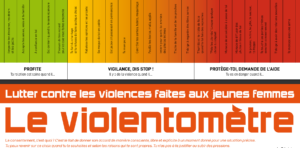
🌟 Le Violentomètre: Identifier et Agir contre les Violences dans les Relations

The Violentometer, developed by the association En avant toute(s), is an awareness-raising tool designed to help individuals identify the signs of violence in their relationships. This visual, practical and accessible guide aims to prevent domestic violence by providing a grid for analyzing behaviors that may go unnoticed or be downplayed.

📋 Understanding the Violentometer

The Violentometer works like a graduated scale, ranging from respectful behavior to dangerous acts requiring urgent intervention. It helps answer crucial questions: Is my relationship healthy? Should I be concerned? Am I in danger?

The three levels identified :

  1. Green zone: Healthy relationship
    • Respect for decisions, trust, shared activities.
    • These behaviors reinforce mutual fulfillment.
  2. Orange zone: Vigilance
    • Control, excessive jealousy, humiliating or manipulative remarks.
    • These attitudes are warning signs that should not be ignored.
  3. Red zone: Danger
    • Physical violence, threats, sexual assault or social isolation.
    • These behaviors require immediate protection and support.

🛠️ Tips and recommendations

  • Identifying toxic behavior: If your partner belittles you, controls your outings or searches your messages, this falls into the orange zone.
  • Don't minimize violence: Gestures such as pushing, slapping or humiliating are serious acts that require distance.
  • Seek help: Contact associations or helplines as soon as the first warning signs appear.

📞 Help resources available

  • Tchat d'En avant toute(s): An online platform for anonymous discussions with professionals trained in violence issues.
  • Emergency number: In case of immediate danger, call 17 or 112.
  • Local associations: Specialized structures offer psychological support, accommodation and legal advice.

"Le Violentomètre" | Centre Hubertine Auclert

Go to data sheet

Guide for associations on welcoming and involving disabled people - Centre Hubertine Auclert


🌟 Guide to Feminism and Disability: For Equality Accessible to All

The Guide à l'usage des associations pour l'accueil et la participation des personnes handicapées, published by the Centre Hubertine Auclert, offers a practical and inclusive approach to integrating disabled people into feminist actions and organizations. This document is also aimed at any structure wishing to improve its accessibility and include all diversities.

📋 Understanding cross-discrimination

Women with disabilities suffer two types of discrimination: gender-based and disability-based. This situation complicates their access to employment, their participation in community life, and their access to essential aids and services. For example:

  • Violence and disability: Disabled women are twice as likely to be victims of physical or sexual violence.
  • Limited access to help: Listening platforms and reception facilities are not always adapted to deaf people or those with reduced mobility.
  • Invisibilization: Lacking accessible resources, few disabled women take part in public or community events.

🛠️ Recommendations for enhanced accessibility

The guide proposes two key steps for making structures accessible and inclusive:

1️⃣ Understanding specific needs

  • Identify obstacles (physical, sensory, organizational).
  • Train teams to better understand different disabilities.
  • Take into account the specific demands of disabled women in feminist actions.

2️⃣ Concrete action

  • Carry out a diagnostic of the accessibility of premises and tools (websites, documents).
  • Adapting practices: Adding subtitles or sign language transcriptions for videos, printing documents in Braille, or providing access ramps.
  • Involving women with disabilities in decision-making and associative actions.

💡 Good practices to adopt

  • Accessibility of premises: Provide wheelchair-accessible areas, elevators or ramps.
  • Inclusive media: Avoid non-accessible PDFs and prefer easy-to-read formats or audio versions.
  • Awareness-raising and training: Training volunteers and employees to welcome people with disabilities.
  • Transparent communication: Clearly indicate in invitations or media whether venues and events are accessible.

Guide "L'égalité femmes-hommes accessible à tou-tes!" | Centre Hubertine Auclert

Go to data sheet

How to manage the employment of people with disabilities - AFMD


🌟 Managing the Employment of People with Disabilities: Good Practices and Recommendations

The guide Comment gérer l'emploi des personnes en situation de handicap (How to manage the employment of disabled people ) published by the AFMD addresses the challenges and solutions associated with the inclusion of disabled workers in the workplace. Drawing on experience feedback and concrete initiatives, this book aims to transform diversity policies into levers of performance and cohesion.

📋 Disability at work: issues and prospects

With the legal obligation to hire 6% of disabled people, companies are faced with organizational and managerial challenges. The 2005 law on equal opportunities strengthened these obligations, while emphasizing the right to compensation, the key to successful inclusion.

Main challenges :

  • Adapt workstations to specific needs.
  • Combating stereotypes and promoting an inclusive culture.
  • Keeping employees with career-related limitations in employment.

🛠️ Best practices for efficient management

  1. Awareness-raising and training
    • Train HR teams and managers in disability-related issues.
    • Organize interactive workshops to demystify visible and invisible disabilities.
  2. Special features
    • Suggest technical adjustments (adapted software, ergonomic furniture).
    • Consider organizational arrangements such as flexible working hours or telecommuting.
  3. Support and dialogue
    • Introduce regular reviews to identify the needs of disabled employees.
    • Set up psychological and social support mechanisms.
  4. Partnerships with specialized organizations
    • Working with associations and adapted structures to promote integration and job retention.
    • Mobilize AGEFIPH funding to adapt workstations.

💡 Examples of successful initiatives

Some companies, such as BNP Paribas and Veolia, have set up innovative systems, such as mentoring platforms, wheelchair tours to raise team awareness, and monitoring committees dedicated to the mobility of disabled employees. These actions strengthen internal cohesion while enhancing the skills of each individual.

AFMD | How to manage the employment of people with disabilities

Go to data sheet

Age management primer - AFMD


🌟 Age Management: A Central Issue for Companies

The Age Management Primer, published by the AFMD, offers an in-depth look at the challenges and opportunities of generational diversity in the workplace. Through an original format, it addresses the key notions required for inclusive age management, while offering practical tools for HR managers and executives.

📋 Why is age management essential?

With increasingly long careers and non-linear career paths, age management has become a strategic issue. It's not just a response to demographic challenges, but also an opportunity to increase cohesion and collective performance.

Companies need to consider age in its many dimensions:

  • Chronological: Linked to the person's actual age.
  • Biological: Related to health and physical capabilities.
  • Cognitive: Linked to self-perception and abilities.
  • Social: Dependent on societal representations and expectations.

⚖️ Deconstructing stereotypes

The document stresses the importance of going beyond simplistic oppositions between young people and seniors. For example:

  • Young people are often perceived as dynamic but inexperienced.
  • Seniors, on the other hand, are seen as experts but not very adaptable.

These stereotypes hinder cooperation and hamper innovation. Proactive intergenerational management enriches exchanges and makes the most of each group's unique skills.

🛠️ Practical recommendations

  1. Creating intergenerational bridges
    Encourage cross-mentoring, where young and old exchange knowledge and experience.
  2. Anticipating career transitions
    Organize mid-career interviews to identify employees' needs and aspirations.
  3. Raising awareness among managers
    Train managers in age bias and promote inclusive communication.
  4. Adapt working conditions
    Offer specific facilities to meet the varied needs of different age groups.
  5. Encourage knowledge transfer
    Integrate mentoring and skills-sharing schemes.

AFMD | Passage, a primer on age management

Go to data sheet

The diversity label: a lever for preventing and combating discrimination - AFMD


🌟 The Diversity Label: a tool to combat discrimination and promote inclusion

Le Label Diversité, un levier pour la prévention et la lutte contre les discriminations, published by the AFMD in partnership with the FACE Foundation, offers a comprehensive methodological guide for companies wishing to embark on a labeling process. This label, launched in 2008 by the French government, embodies a formal commitment to combating discrimination and promoting inclusion, through exemplary human resources management practices.

📋 The Diversity Label: Definition and Challenges

The Label Diversité recognizes companies and organizations that are actively committed to preventing discrimination and promoting equal opportunity. The label covers the 18 discrimination criteria recognized by law, such as origin, gender, disability, age and union membership. It is part of a continuous improvement approach to our practices.

Why get involved?

  • Enhanced corporate image: A strong signal sent to stakeholders (customers, employees, partners).
  • Strengthening internal cohesion: collective mobilization around the values of fairness and respect.
  • Reduced legal risks: In compliance with anti-discrimination legislation.
  • Increased attractiveness: Particularly to talent from diverse backgrounds.

⚖️ Labelling stages

  1. Preparation :
    • Appointment of a diversity coordinator.
    • Creation of a steering committee.
    • Definition of a labelling perimeter.
  2. Diagnosis :
    • Inventory of HR practices and internal processes.
    • Identifying risks of discrimination.
  3. Diversity policy implementation :
    • Formalization of an action plan.
    • Team training.
    • Setting up listening and alert mechanisms.
  4. External assessment by AFNOR :
    • Practice audit.
    • Opinion of the multiparty labeling commission.
  5. Follow-up and renewal :
    • Interim evaluation at 18 months.
    • Renewal after 3 years.

🛠️ Recommendations for a Successful Approach

  • Involving management: The support of the company's governing body is essential to the success of the project.
  • Raising awareness among all employees: Through training on non-discrimination and workshops on stereotypes.
  • Adopt a participatory approach: Include social partners and employees in the process.
  • Communicate effectively: Promote the diversity policy in internal tools and external campaigns.
  • Rely on experts: Collaborate with specialized organizations to ensure the relevance of our actions.

AFMD | The Diversity Label, a lever for preventing and combating discrimination. Obtaining and maintaining your label".

Go to data sheet